
Someone else's problem
What happens when rural towns are worth less than the work it takes to save them?

Across the street, a family is clearing out their house. They have already filled two roll-off dumpsters. I watch as they drag things from the house and yard to fill a third.
I’m impressed by their progress. That house was discussed in a city council meeting shortly after I was elected. Another neighbor came to complain about a pest infestation, which was allegedly spreading from their house to hers.
I knew they were partially living in a camper next to the house, violating at least one ill-enforced city ordinance. But I didn’t know — until I found out at the city council meeting — that they were dumping their raw sewage in the ditch.
I felt a little queasy when I heard it. All last year, I sometimes caught a whiff of a manure-like smell on warm days; I blamed it on the cows north of town. But of course untreated human waste might smell the same.
I wasn’t angry, though. It is, as people say, shaking their heads, a sad situation. The wife has dementia. The husband was ill-equipped to care for her alone. I heard that the house was basically uninhabitable, partially because she couldn’t handle the confusion of throwing anything away. But I don’t know this for sure.
I also don’t know if the city council discussion spurred action. The situation was evolving even without our involvement. But the family found a spot for the woman at a nursing home three hours away while they wait for something closer to open up. They are cleaning out the house. And I don’t smell manure now even as the days get hotter.
I don’t know if anyone will live there after the clean-out, or whether it will be abandoned where it stands. But at least they are taking care of it. Usually, the end of this story would be to make it someone else’s problem.
I don’t know any other venture capitalist in America who lives within smelling distance of a raw sewage problem. If you know one, please connect me, because I would like to make a friend.
I sit in day job meetings and talk about capital deployment, fund returns, and tax strategies.
I walk around town in the fading evening light and see no capital and no returns. And the only clever tax strategies involve abandoning property when you no longer want to maintain it. While most of America is concerned with the housing affordability crisis, I am surrounded by homes that are, perhaps, too cheap.
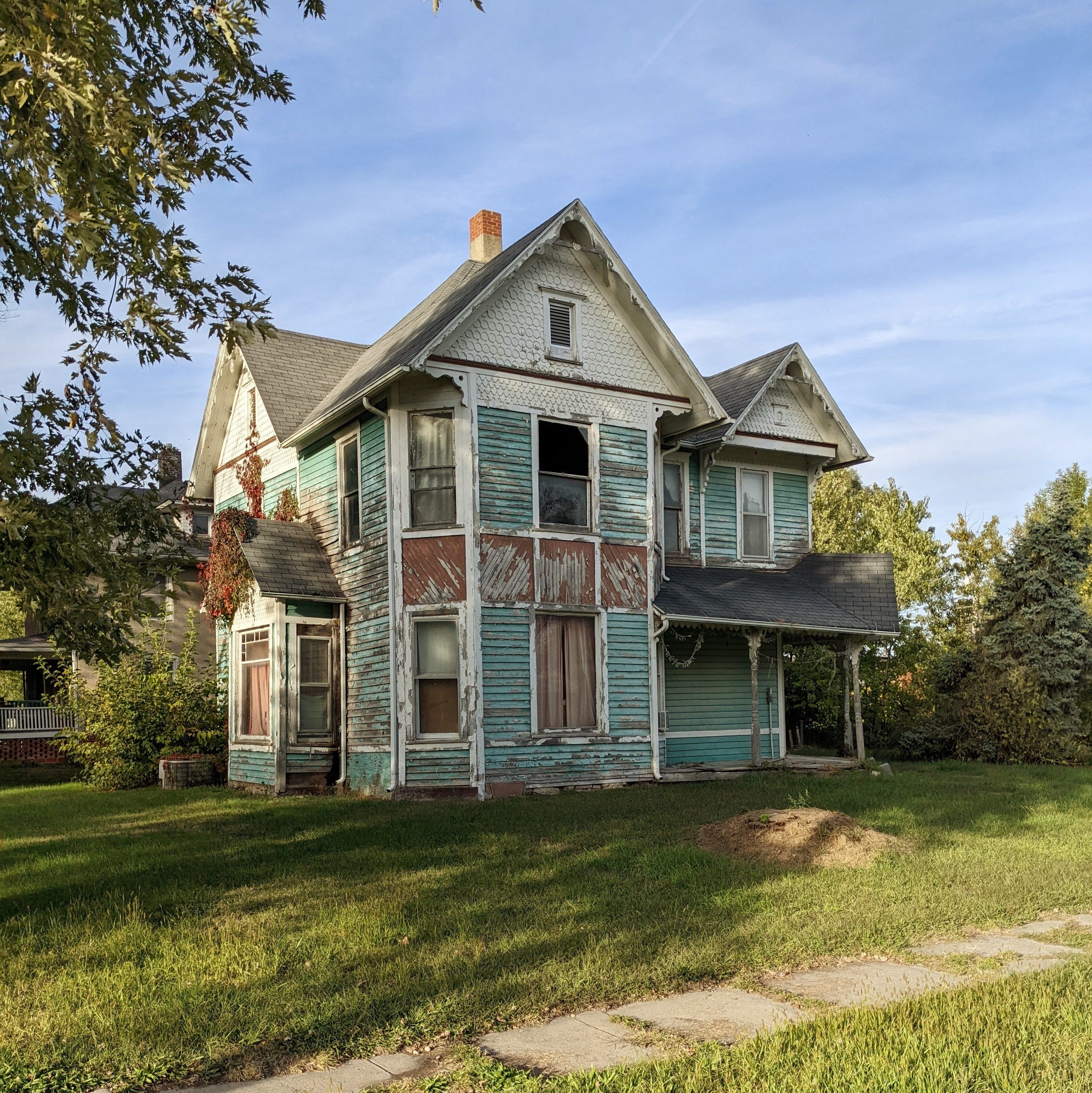
The economics of rural Iowa are divorced from the standard real estate market. The cost of new construction is a “real world” cost: building a new house requires hundreds of thousands of dollars for materials and labor, as it would anywhere else. But the cost of buying most existing houses is so low — sometimes less than $10,000 — that the standard incentives to maintain property and make improvements do not apply.
This creates a visible, visceral vibe in every small town in southern Iowa. Beauty and whimsy and complete neglect are all commingled, with no zoning rules or HOAs to force homogeneity.
Investments here are driven by human desire, not by rational economic incentives. Some houses have nice new decks and beautiful gardens. Some houses have absurd yard ornamentation; you still see gnomes here, and garden figurines, and rusting collectibles, long after they were wiped from the suburbs by more minimalist trends. Some houses hide beautiful spaces behind rustic façades.
They sit next to houses with broken windows covered in plastic sheeting, or houses missing half their siding, or houses where no one has lived since I was a kid. They sit next to houses that depress the market so deeply that any improvement, from a new roof to a remodeled kitchen, is unlikely to be recouped.
There is no “good neighborhood” or “bad neighborhood” in these towns. People maintain their places, or they don’t. And if a place isn’t maintained, there often isn’t an incentive for their heirs to try to sell. Easier to let the house rot, often with the contents still inside, than do weeks of work to net a couple thousand dollars.
Have you heard of property tax sales? The rules vary by state; in Iowa, if someone fails to pay their property taxes, those taxes are eventually sold at a tax sale. The buyer pays the unpaid taxes in exchange for a lien on the property. The original owner has two years to pay back the taxes and interest. If they do not, the lien holder can foreclose and take the property.
This is meant to create strong incentive for owners to pay their taxes. Most rational actors in most rational property markets will not risk losing their homes over unpaid property taxes.
But here, it has the opposite effect. If your house is unlivable and unsellable, why pay the taxes? Especially when not paying your taxes means it will eventually be seized — with no impact at all to your credit score, since it’s not a bankruptcy or mortgage default — and become someone else’s problem?
I got my house the old-fashioned way: a handshake agreement with a man named Marvin. He seemed leery of selling to a single woman until my dad sat on his deck, explained my tech career + my romance novels, and said that if I thought I could afford to buy Marvin’s house, I wasn’t lying. It was one of the most expensive houses in town, and absurdly cheap compared to what I was leaving in Denver.
I moved back here after two decades away. It was, in many ways, an opting out — out of my last job, which I had grown to hate; out of a half-duplex in Colorado that had grown claustrophobic during the pandemic; out of a series of life choices that had begun to feel all wrong.
It was also an opting in — into more time with my family as my dad was dying; into a community that I wanted to rediscover; into writing and gardening and a softer connection to my body and my physical environment.
But that’s a self-congratulatory read on the situation.
It’s still all too easy for me to opt out. I still have the internet, which means hours of doomscrolling is a thumb-length away. I still have a tech job, which means I can afford to travel when I need some big-city stimulation. And even when I’m home, I can opt out of all the local work if I want to.
I can’t avoid seeing what’s in front of me, though.
Down the street, a man has set up camp outside a burned-out shell of a manufactured home. The previous owners intentionally burned it in an attempt to clean it up, but then abandoned the effort. They stopped paying their taxes. The investor who ended up with it sold it to this new guy for $3800, which seems high.
The newcomer has a white van. He fashioned an awning off the side with camo-colored tarp. He sits outside in a camp chair most evenings, reading and drinking from a metal coffee cup, shaded by the trees that didn’t burn in the fire. He waves when I pass by. I wonder if he will fix up the house in time to move inside by winter, or if this is his “summer retreat,” or if he will be the next person to abandon it.
I wonder where his sewage goes. Luckily the wind is almost never out of the east, so I can choose to believe he has a composting toilet.
Across town, someone from Anacortes, Washington, owns almost a whole city block. It includes two abandoned Victorian houses and a shed that is a mere suggestion of a building; the houses are boarded up, and the shed’s roof is mostly gone. The deed transfers all show that he acquired these properties for $0. He came several times in the early pandemic to work on the most viable house. He engaged with various locals and seemed eager to move here. But my understanding is that when his wife came with him, she saw how much work the house needed + how vastly different life would be here. He still pays his property taxes, but he has not been back in years.
At a recent city council meeting, another resident came to respond to one of our warnings. We had given him thirty days to start cleaning up his property. His yard is full of detritus — broken mowers, scrap metal, junk cars, etc. He was polite, but claimed to be completely at a loss as to how he might sell or donate or toss anything. We told him he could hide it all behind a fence. He said that building a fence would cost more than the house was worth. Since he bought the house for $3900 after someone else lost it for unpaid taxes, he’s probably right.
He said he had moved here “for the freedom” — perhaps thinking that might land on sympathetic ears. It did not, but we gave him another thirty days to show progress. Ultimately, though, there’s not much we can do. We can fine him, but will he pay it? And if the city ultimately gets the property — which we can do by condemning it — then it becomes our problem.
I see these characters, and a dozen more, as I wander around town and daydream of what I could do to help the economy here. I want to start a retreat center with a huge maker space for weeklong classes. I want to buy the abandoned gas station, and the derelict brick buildings on the main street, and the fading hotel that used to serve rail passengers. I want to buy my grandparents’ old store, which they sold in the 1990s for $5,000 and which is probably worth less now, and turn it into a mercantile. I want to create enough momentum for people to come and stay awhile — for other people to opt in.
But do I want to sink my life savings, and my life’s work, into that kind of investment?
I suppose it depends on what might be considered a worthwhile return.
From a purely financial perspective, everything I described above is a “bad investment.” It would be easier to light a pile of cash on fire than to put in all the work of renovating a town that no one will visit. I know the guys who run the natural gas company in town; they’d probably help me install an eternal flame as a monument to my own stupidity.
But the desire to pour myself into this place is strong. There is a (slim) chance that I could be like Alice Walton, turning Bentonville, Arkansas, into a major art mecca — but without her Walmart billions, it’s more likely that I would be like Emperor Norton, the man who wandered around San Francisco’s Gold Rush pretending he ruled the United States. Other people humored him, because that’s what people do with harmless eccentrics.
I think again of the guy who moved here “for the freedom” — as though the most desirable thing on earth is to have a plot of land to pollute. That is, perhaps, not fair. Hoarding, like dementia, is a disease. It feels all too prevalent here. Poverty and scarcity cause most of us to hold on to things long past the point where we should have let them go.
What causes me to hold on to this place? Memory? Ancestry? Some desire to fix problems — for a town, for a community — that I did not cause and were never mine to solve?
I don’t know what to do next here, but I feel I must do something. An anticlimactic note to end on, but there’s no pithy summary. I genuinely do not know what to do next, beyond showing up to city council meetings, and dreaming up projects, and sometimes writing about them for you.
However this turns out, though, please humor me, as you would any harmless eccentric.
Cheers,
Sara
p.s. If you haven’t subscribed yet, please do — it’s a free and easy way to support my work. I’m grateful you’re here!
p.p.s. If you missed my last post, I wrote about the shifting contracts in rural Iowa — including disappearing service from UPS:

Such vivid, haunting images. The fact that you moved back, that you ran for city council, that you haven’t given up…that’s everything. I’m in a tiny town in Japan, where the village is largely deserted now, but the owners of an onsen resort have created a little oasis for Japanese tourists. Because the brothers once spent some time in the US and love craft beer, they created a Chicago-style rib joint with a craft beer (naturally called Ninja). I don’t know how they’re hanging on, but admire the effort. It’s rice country, but here, too, they face the struggle of enough people to do the work of bring food to the table. A man in the village decided in his retirement to revive the family indigo business, but so far none of his children are picking it up in his wake.
Love the retreat center.
Reading this post because someone I follow liked and shared it. I just finished a book called Islands of Abandonment by Cal Flyn which documents various abandoned areas (for many different reasons) but she discusses Detroit in one section, which sounds oddly similar to your situation. Definitely recommend reading it, though it offers no solutions. Will happily offload some of the Texas population into Iowa, however. We continue build and eat land by the day and it’s becoming too much. Convince HP or some tech bro in Austin that Iowa is the new place to be.